
Written by: Keith Sigfred Ancheta, Isabella Ann Mendoza, Justine Nicole Torres, and Cecilia Therese Guiao
Originally published on Climate Tracker Asia
The first global stocktake (GST), which assessed the progress of countries towards achieving the long-term goals of the Paris Agreement, concluded at COP28 in Dubai (2023), revealing the ambition gaps that countries need to close. Its findings were meant to guide countries in enhancing their contribution to the achievement of these goals based on their national priorities and circumstances, or their Nationally Determined Contributions (NDCs), which were due in February 2025. However, only 13 countries were able to submit their enhanced NDCs by the deadline set by the UN Climate Change Secretariat.
The first global stocktake (GST), completed at COP28 in Dubai last year, assessed countries’ progress towards the Paris Agreement’s goals – and revealed just how far the world still is from closing ambition gaps. Its findings were meant to guide countries in enhancing their Nationally Determined Contributions (NDCs), due in February 2025. However, only 13 countries submitted their enhanced NDCs by the UN deadline.
The NDC is central to the Paris Agreement, mandating each country to develop its mitigation targets and update them periodically to ensure increasing ambition. Unlike the Kyoto Protocol, which bound countries to a specific target, the Paris Agreement established a process that allows countries to determine their contribution to the global mitigation effort, highlighting the principle of common but differentiated responsibilities and respective capabilities (CBDRRC).
The Philippines submitted its first NDC in April 2021, committing to an emission reduction and avoidance target of 75% by 2030 relative to 2010 emissions levels. It covers five sectors: agriculture, waste, industrial process and product use, transport, and energy. Although this target seems high, 72.29% of it is conditional on support from developed countries, and only 2.71% can be pursued with domestic financing. Different stakeholders have mixed reactions to this target, but the government has since stressed that it is aspirational and a political tool and that the country could leverage the country’s climate vulnerability to access finance and other means of implementation (MOI).
Although this target seems high, 72.29% of it is conditional on support from developed countries, and only 2.71% can be pursued with domestic financing. Different stakeholders have mixed reactions to this target, but the government has since stressed that it is aspirational and a political tool that the country could leverage to access finance and other means of implementation (MOI) given its climate vulnerability.
It’s one thing to have a high mitigation target; it’s another thing to have readily implementable policies and measures (PAMs) and be able to put them into action. The Philippines’ NDC Implementation Plan, released in 2023, outlined the PAMs that the country commits to implementing to achieve its target. It is noteworthy that, according to the NDCIP, if these identified PAMs were to be fully implemented, they would only add up to around 39% emissions reductions. The lack of a comprehensive and transparent measurement, review, and verification mechanism has also left non-government stakeholders in the dark regarding the real progress of the implementation of the NDC. Aside from that, the financial and investment strategy for the NDC, which should detail how the conditional targets will be financed, has yet to be published, which leaves a lot of uncertainty around the implementation of conditional targets.
In December 2024, the government held a multistakeholder forum on the NDC updating process. Lead government agencies shared the progress on the implementation of the PAMs for each sector, which was limited; this was attributed largely to barriers such as inadequate flow of MOIs. They also shared that the country intends to submit its enhanced targets before the 30th session of the UN Climate Negotiations, with the support and assistance from the newly established Development Partners Coordination Group, led by the Asian Development Bank.
On June 9, Parabukas launched a report on the NDC enhancement process that the country is undertaking to look at how the country’s climate targets could align with the 1.5˚C goal of the Paris Agreement, and bridge the understanding of various stakeholders on how “high ambition” should be reflected in the NDC.
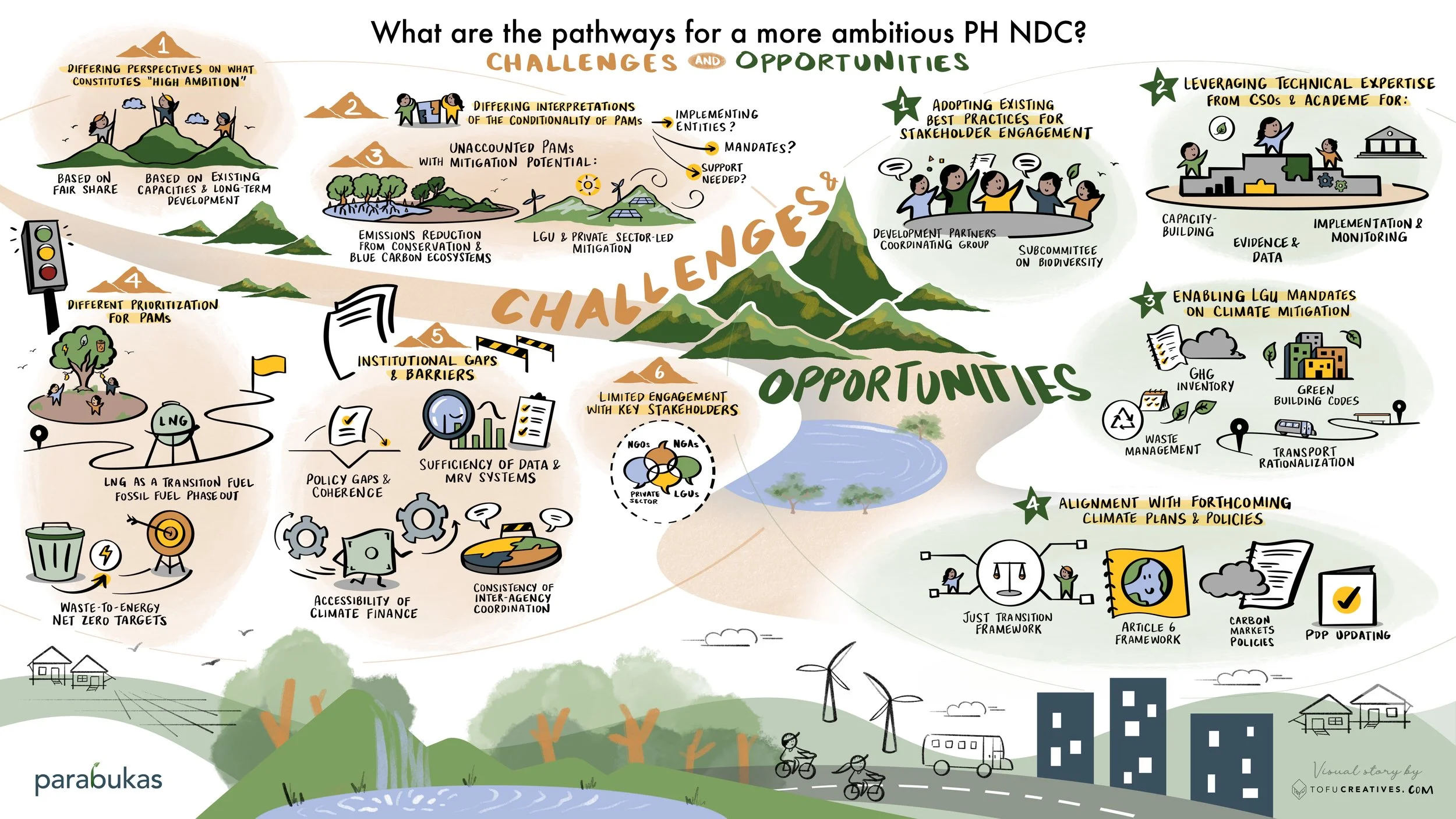
Key insights from key informant interviews and consultation workshops include the following:
Government and CSOs have differing perspectives on the basis for “high ambition” for the next NDC. It was revealed that there are diverging views on what constitutes “high ambition” among various stakeholders. Some associate it with the increase in the mitigation target, particularly the unconditional target, while others emphasize improved qualities, such as inclusion in the process and the integration of just transition principles and PAMs.
A common understanding of “conditionality” is needed among sectoral agencies. While the first NDC briefly differentiated between conditional and unconditional targets, sectoral agencies have different appreciations of conditionality, resulting in an inconsistent approach for tagging PAMs.
Numerous existing PAMs and active programs are not accounted for in the current NDC. Many government programs already have mitigation potential and can contribute towards achieving our NDC target, such as initiatives of local governments (e.g., energy efficiency initiatives) and some biodiversity-related programs (e.g., programs on mangrove forests and blue carbon ecosystems). Still, these programs and the emissions reductions that they generate are not yet included in the NDC. There are also private-sector-led initiatives that are not accounted for.
Government and civil society have markedly different priorities as regards which PAMs to prioritize to increase ambition, particularly in the energy sector. Civil society groups are wary of the inclusion of PAMs that they view as “false solutions,” such as Waste to Energy and nuclear facilities. In contrast, the government is more technology agnostic, prioritizing energy security and affordability, and as such, considers PAMs that have mitigation potential regardless of the technology.
NDC target setting and PAMS implementation can be enhanced and expedited if institutional barriers and policy and data gaps are addressed. Various stakeholders, including government agencies, recognize the presence of barriers and gaps that hinder the NDC process, be it the lack of or inconsistent baseline data, the absence of an MRV system, and inconsistent finance flow from external sources.
Processes that ensure the meaningful participation of civil society stakeholders may help ensure that targets are robust and PAMs are coherent. The civil society felt that their participation in the previous NDC crafting and implementation process was inadequate and lacking in transparency. They highlighted existing expertise and capacities that could help with both target setting and implementation.
As a path forward, the study identifies key recommendations that the government could undertake to address the findings of the study in the short and long term. In the forthcoming months, as the government finalizes updating, it could fully incorporate mitigation initiatives undertaken by local governments and the private sector, in addition to mandated sectoral PAMs, to increase its unconditional commitment. It could also draw upon available research and projections from civil society organizations when crafting enhanced NDC targets to address the gaps in data and other barriers.
Beyond this current enhancement cycle, the government should establish clearer timelines and institutional arrangements for consistent NDC assessment and updating to mitigate the barriers hindering the process, and ensure that these arrangements include robust platforms for civil society organization (CSO) participation in 1) target setting, 2) identification of PAMs for the NDC Implementation Plan, and 3) progress assessments. This should also include a process to systematically include currently unaccounted PAMs and active programs in future NDCs. Finally, to address the policy gaps for the NDC and other climate policies, the government should ensure strong coherence between the NDCs, the NDCIP, and other national plans and roadmaps related to climate and the environment.
By reflecting on the key findings of the study and operationalizing its recommendations, the country may ensure that it will present its highest possible condition while still upholding the principle of equity and enshrining climate justice in its climate policy framework
The full report is published on the Resources Page of the Parabukas website.